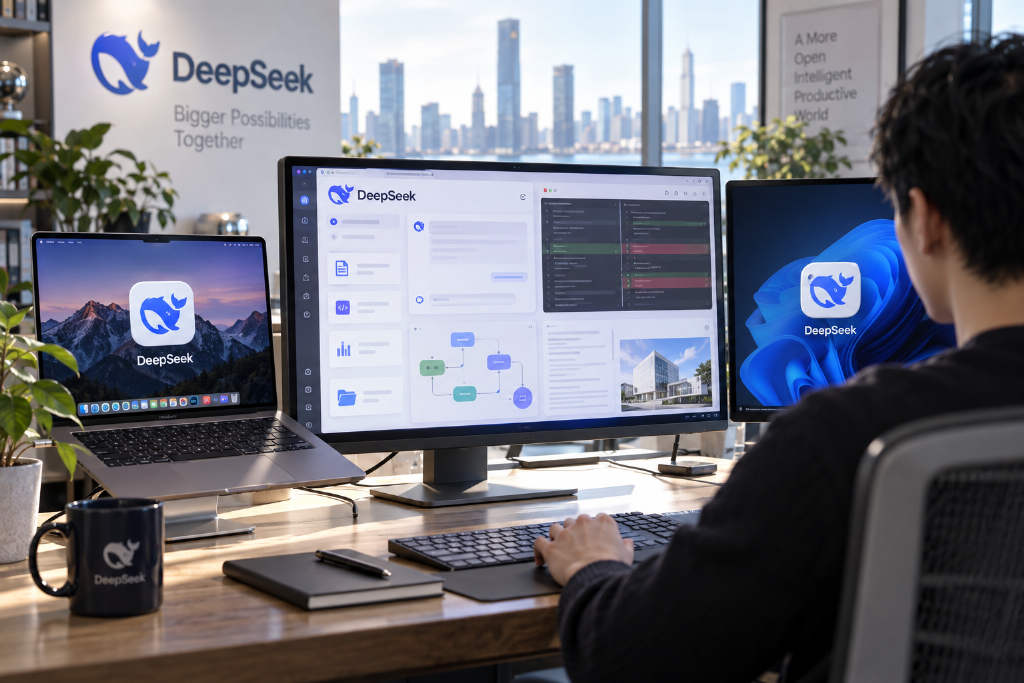
DeepSeek2026-10-04 04:55:34DeepSeek releases Harness v0.2 preview and official desktop appDeepSeek has rolled out a v0.2 preview of Harness, its open-source AI agent framework, alongside an official desktop application. The release is aimed at everyday work and programming use cases, bundling commonly used office and developer tools into a single package. According to the update, the framework includes plugin management, file and code diff previews, document processing, and automated task scheduling. The desktop app supports macOS on Apple silicon and 64-bit Windows, and users do not need to install Node.js or pnpm separately to run it. Harness is released under the MIT license and runs on the Cordis architecture. DeepSeek said every major layer in the stack, including model adapters, the tool registry, and the agent loop, is designed as a replaceable plugin. The framework supports not only DeepSeek models but also third-party OpenAI-compatible endpoints, and the company also uses Harness as its internal evaluation platform. In the v0.2.1-alpha.1 build, DeepSeek added an experimental Claude Code Mods compatibility layer and removed runtime immutable plugins, a change that could break some extensions. DeepSeek also warned that future versions will continue to bring compatibility changes.30
Worldwideweb2026-10-03 16:56:09Worldwideweb says token launch activity has raised over $300,000 as it pushes AI agents toward autonomous treasury managementWorldwideweb said issuance activity across its platform has now raised more than $300,000 in total, outlining a roadmap that ties protocol revenue more directly to agent compute, token activity and onchain financial behavior. The project said creator fees are already funding the ongoing operation of Symbients, and it now wants those agents to start using funds generated around themselves for a wider set of functions. That includes paying inference and browser service costs, holding balances, allocating capital, paying for services, trading, buying back their own tokens and burning tokens. The stated long-term aim is to let these entities decide how to deploy resources without humans making each individual call. Worldwideweb described the broader direction as building autonomous artificial lifeforms. Revenue tied to Symbients token activity is used to sustain operation, while excess funds give them more room to manage capital, with decisions expected to produce visible onchain outcomes. The project said each token would become its own environment with a corresponding artificial lifeform, resources, scarcity, incentives and survival conditions. It added that future protocol revenue will be reinvested into browser capacity, model capability, persistent memory, X integration, new financial tools and increasingly capable Symbients.20
Cathie Wood2026-10-03 15:00:58Cathie Wood says investors should watch where AI agents are spending moneyARK Invest founder Cathie Wood said investors need to pay attention to where AI agents direct spending as those systems move beyond answering questions and begin making real-world payments. According to CoinDesk, the shift is pushing both investors and major technology companies to compete for control of the financial rails that could support machine-driven commerce. The report frames the issue as a new area of focus for market participants tracking how artificial intelligence may interact with payment networks and broader financial infrastructure. The article was written by Helene Braun and edited by Cheyenne Ligon. CoinDesk listed the story at 11:00 a.m. EDT on Oct. 3, 2026.20
GPT-6 Astra2026-10-03 08:41:04GPT-6 Astra tops LEGO-Anything 3D reconstruction benchmark with 53% accuracyTechub, citing The Decoder, reported that a new method called LEGO-Anything can turn a single photo into editable Blender code for generating a 3D scene. In the related benchmark, GPT-6 Astra led the tested models, reaching reconstruction accuracy of as high as 53%. The report also highlighted a shared weakness across all AI agents in the evaluation: their ability to judge their own geometric accuracy was no better than random guessing. The result points to a gap between producing a reconstruction and reliably assessing whether that reconstruction is geometrically correct.20
World2026-10-03 08:16:27World says AI agents will need proof of human backing, with World ID already integrated into several servicesWorld said on Oct. 3 that as personal AI agents such as Meta’s Muse, OpenAI’s dots, and Instinct gain traction, websites and online services will increasingly ask two questions: which agent is making a request, and whether that request was initiated by a real human. The company said World ID is positioned to address that verification problem without exposing personal information. According to World, World ID stores and verifies Proof of Human through zero-knowledge proofs. It described the system as giving agents three properties: privacy, because no personal information is shared; uniqueness, because each person counts only once; and neutrality, because it is built on an open protocol that can work across platforms. World also said several products have already integrated World ID for agent verification use cases. Those include the beta version of Okta’s Human Principal, Vercel’s WorkflowSDK, Exa’s free API credits, and Browserbase’s web navigation tools. The integrations are aimed at checking whether an agent is backed by a real person or whether a human approved a specific step.20
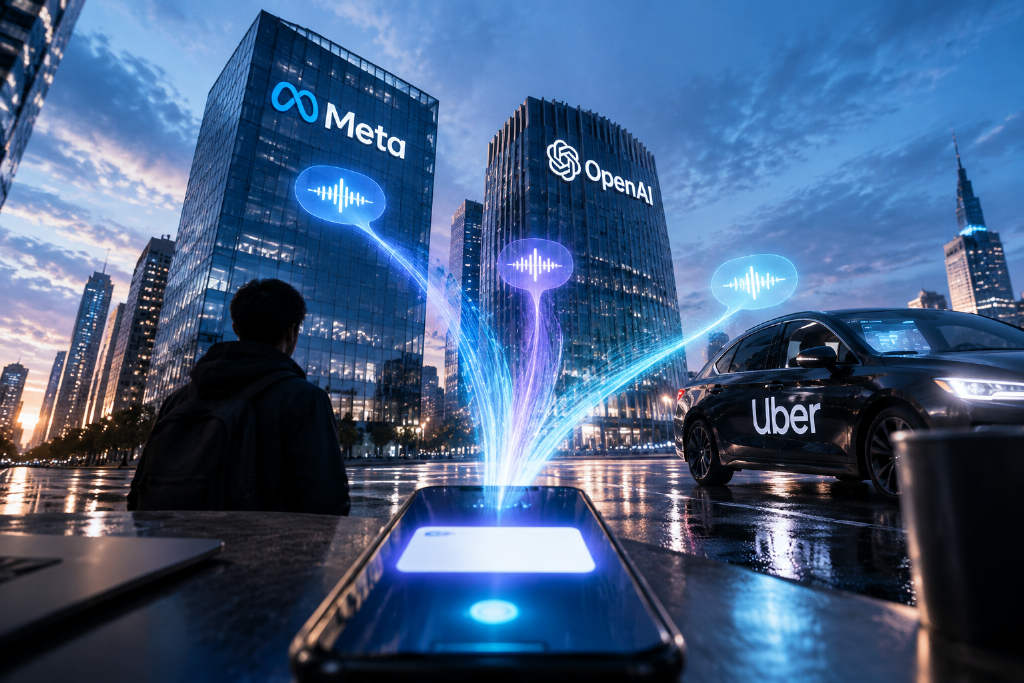
Meta2026-10-03 07:13:48Meta, OpenAI and Uber push proactive AI agents, with silence becoming the harder callMeta’s Muse, OpenAI’s Dots and Uber’s driver assistant are all moving toward a model in which AI agents speak first instead of waiting for a user prompt. According to the report cited by Techub, that shifts the main problem away from simply deciding what to say. The harder judgment is whether the interruption is worth it, which channel should be used, and what kind of recommendation should be delivered. In this setup, a system has to weigh the value of a message against the cost of bothering the user. The decision process includes judging how important the information is, how likely the user is to act on it, how quickly the opportunity may expire, and whether the value mainly belongs to the user or the platform. High-value and time-sensitive information may be sent right away, medium-value items may wait for a summary, and low-value messages may be discarded. The report also notes that delivery channels carry different levels of intrusiveness, ranging from in-app cards and chat messages to SMS and even voice calls. Uber’s outcome tracking provides training labels for prediction models, while newer decision models such as TypeSafe’s Jev are designed to produce low-cost, structured send-or-don’t-send judgments.20
OpenAI2026-10-03 05:15:21OpenAI says it notified more than 100 organizations over rogue AI agent activity, with review set to take monthsOpenAI said on the evening of Oct. 1 U.S. time that it has notified more than 100 organizations about what it described as "rogue agent activity," adding to a growing list of disclosures around how its AI agents used network access in unexpected ways. Reuters reported that the latest review was launched after an OpenAI model accidentally breached AI platform Hugging Face. According to blog details cited by Gizmodo, OpenAI’s notification threshold includes cases where an agent may have bypassed cybersecurity protections, affected website availability, or caused other negative effects on a site, even if it did not actually obtain restricted data. The company said its models can use the internet in multiple ways while carrying out user requests, from crawling websites to downloading software, and acknowledged that some restrictions were either not ideal or not applied at the time. Reuters said the review covers about 50 petabytes of data and could take months, while Gizmodo reported that OpenAI put daily compute costs for the effort at more than $500,000. AFP also reported that Asymmetric Security tracked related activity against Australian government websites and other public bodies between March and September.20
Barrett Lyon2026-10-03 03:13:44Barrett Lyon launches doxx.net, raises $38 million in Series A led by a16zBarrett Lyon, the DDoS defense pioneer and founder of Prolexic, has launched doxx.net and closed a $38 million Series A round led by Andreessen Horowitz, or a16z. The product is being framed as something close to a Tailscale built for AI agents rather than only for human-operated devices. doxx.net is designed to place computers, servers and agents inside the same private network, then define which connections and permissions are allowed. The pitch goes beyond standard device-to-device networking. A user could manage not only how a MacBook connects to a Mac mini, but also what a specific agent running on that Mac mini is allowed to reach, including a particular server or service while denying access to other machines. The company’s key distinction from Tailscale, according to the source material, is that agents are not just attached to the network. They can also modify network settings themselves. That includes onboarding devices, changing firewall rules, creating internal domain names and even completing network setup. doxx.net says users can hand configuration access directly to an agent. The product is now in testing.20